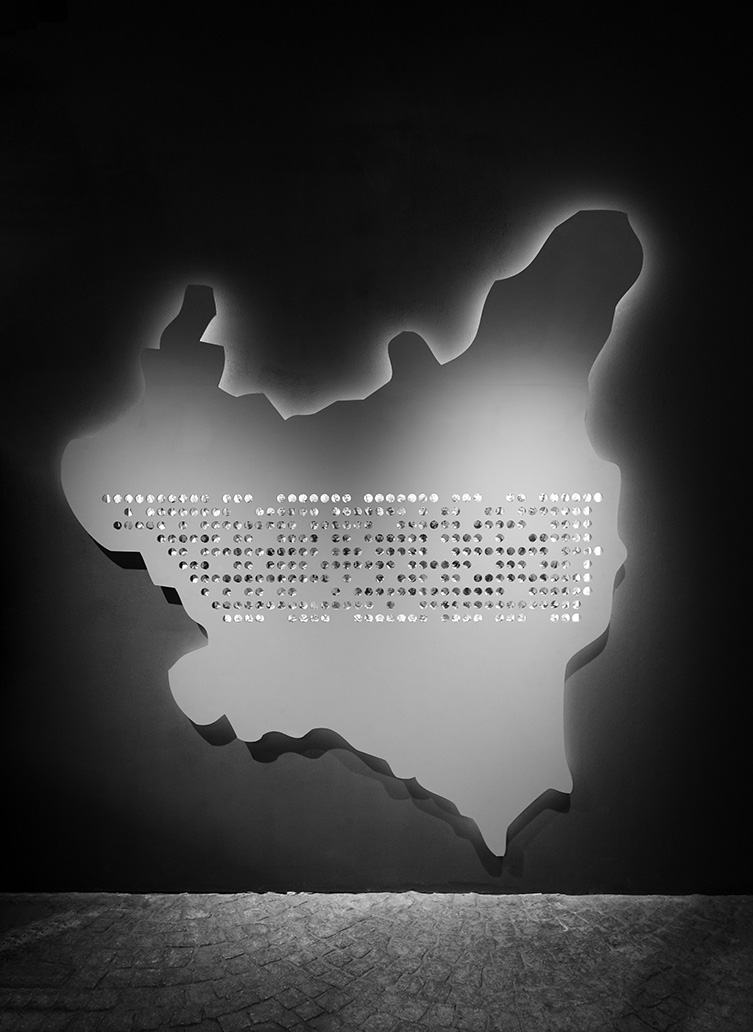
WARSAW: DISPLAY OF MEMORY (2026)
In Georges Perec’s masterpiece, Life: A User’s Manual, the writer guides us, page by page, to get to know the tenants of a Parisian house on Rue Simon-Crubellier, through their memories and the narration of what happens or has happened in those spaces, also describing the rooms and objects that, like the people, inhabit and bring them to life. Similarly, Suzanne Preston Blier, an art and architecture historian and Africa specialist at Harvard University, reminds us that “Houses are living organisms. Like trees, they have life stories, which consist in the unfolding of their relationships with the human and non-human components of their environments.”(1) Useful references for understanding the investigation carried out in Warsaw by Claudio Gobbi, presented in the exhibition space of the Italian Cultural Institute in Warsaw with eight banners, each of which tells the story of a piece of architecture in which, following a model already tested in other works, the author combines previously unpublished images he created with others retrieved from archives and then reworked, or even created with the aid of artificial intelligence. The interior spaces of the Varso Tower—the tallest tower in the European Union—expand the concept of building to encompass that of inhabiting: the photographs depict an environment populated not by human beings but by elements that signify their temporary absence or serve as substitutes—a tree, a surveillance camera, an empty sofa, a panoramic telescope—thus defining a space in a state of constant flux. The series dedicated to the Hammer Building, an iconic modernist structure built after World War II, offers the same reflection while reversing its dynamics: it is not the objects that evoke the absence of human beings, but the space itself that bears witness to a presence that need not be displayed to be felt. As if to round out both series, here are images of scale models and mock-ups that refer to the design phase of the buildings and suggest their completeness, the idea of something with a beginning and an end. However, this defined and complete dimension comes into tension with the open, animated, and collective one that the buildings themselves seem to signify in the photographic presentation. *
* Excerpt from the text by Filippo Maggia, curator of the exhibition.